Monday, 13 May 2013

COP PUBLICATION DEVELOPMENT WORK

The publication I was designing would fit inside your average CD case, I have decided that the format would be 116mm by 120mm so that it will fit snug inside the Case. I have decided to go with the theme of yellow black and white as this is how most CCTV signs are represented and also yellow and black are warning colours and have connotations of power and order. 

FRONT COVER


 I decided the best way to represent panopticism visually would be to use the all seeing eye, as this is essentially what it is. Its the constant watch of the world, the triangle/pyramid is a shape that represents power structure and order, whilst also giving reference to Warning CCTV camera signs which are triangular. The eye refers to the constant watch.

I tweaked around with the design, trying out the stencil lettering 
as used in the props but was not really happy with the out come.
I decided the imagery was too simple so I drew a more intricit eye
which made the logo stand out more. The detail of the eye creates
a more informed gaze with the viewer.  
 I added yellow to the design to reference the CCTV signs.
 I experimented with using type but I feel 
this wasn't really that necessary. 
 Ruins the white space

 I like this version but I feel there is too much going on
Looks a bit like a illusion - reference to hypnotism & control 
 
 Pattern Experiment.

CONTENT & DESIGN

PHOTO SELECTION

I took frames from each of the videos and turned them into black and white photos in order to stick with the colour scheme and also reference a CCTV monitor. Here are a selcetion of possibilities

lost & found
 keep out
 gaze in advertising
 gaze in advertising
keep out
 intrigued passer
 women payed no attention to the box
She stood right next to it for ages and then
finally stood in the box 
slows down to read
 acting up to the camera
 came to read the sign
 slowed down
 Girl and boy friend intrigued
 one of the only people to look in the box
Young girls debated whether to look in the box
for a good minute or so 
 young boy stops for a look
 young girl smiles the camera out
 girl poses for the camera
 this lad had a quick pose
face pulling
group of girls loved the  bit of attention
more posing
 ...
couple posing
woman testing retribution
 more...
 signage
Camera
 Road markings on both sides
  Speedo


DESIGNING

After I had carried out my experiments It was time to right up my experiments. I started the book with an explanation of panoptocism which highlights the 3 panoptic techniques, with an explanation of what the tests were about and how they turned out. I used relevant quotes from my essay to explain aspects of the experiments.

 I experimented with different page formats I decided the version on the left was more versatile and
allowed for more text. The black and yellow combo would be quite heavy on the eyes and quite dull.


The black and yellow colour scheme ran through out the publication.


I tried to use simple imagery on each page to visually represent
the experiment.


I decided to center justify my text in order to represent signage which 
is generally in this format.

FONTS
 I decided to Use arial Black and Arial Rounded MT as both these fonts are used on many
government signage around the UK, they have impact and work well together.
 

To improve the visual quality of the book I greyscaled all the images in order to fit in with the colour scheme. Coloured photos ruined the aesthetics.


I wrote a small section on the digital footprint in today's society highlighting some of the ways we are documented and registered online and elsewhere. It also touches on consumerism and personal online targeted adverts which are becoming ever more present in today's society.


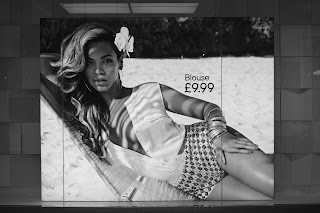
I also looked at examples of adverts in the trinity center which women as an extension of the gaze. These large scale provocative images are all over the trinity center. This can have an affect on the way women feel about their bodies which can have a negative effect. It can also attract the attention of males who will be influenced to buy the items for the girlfriends etc, as it gives the impression that's how they will look if they wear it.


To break up the white space I drew simple illustrations which referenced the topic.

Now for Print... 

Sunday, 12 May 2013

VIDEO FOOTAGE - PRIMARY RESEARCH

I decided to cut down the number of experiments I was doing as some of them had similar concepts so there was no point doing them. For instance glueng the pound to the floor and the jewelery box experiment are quite similar. I decided to narrow it down to, speed cameras, the box in the ring, the keep out box and the smile for the camera test. I will asses the footage afterwards to find examples of people playing up to the camera.


LOST & FOUND 1st ATTEMPT FAIL


The first attempt at shooting this experiment didn't really go according to plan. But showed the Trinity Centers panoptic forces coming into play. I decided to best place to do the experiment would be the busy ground floor, then film from the 1st floor balcony. I left the box and sign n the floor but within seconds somebody had kicked it out of the way.  This was pretty annoying as I had to keep putting it back to its propper place. Shortly afterwards security had cottoned on and come over to crash the party. At first they were pretty unhappy with what I was doing. I explained the project and how I had rang earlier in the week. I was then escorted to customer services where I spent a good 15 minutes sweet talking them into letting me film.

LOST & FOUND LOCATION CHANGE


I decided that it was far too busy to carry the experiment downstairs so we were able to film inside customer services. This was perfect as there was a glare on the glass from the outside so the camera was barely visible. This turned out to be the perfect spot to shoot. It wasn't too crowded so it wasn't kicked as often. It was quite fun to watch on the sly, the camera was positioned in a way that passers by wouldn't notice it. There were a few members of the public that interacted with the Box, but were weary of being watched as they looked around to check if they were being watched. It was generally the younger members of the public that paid the most attention to it. The sign worked that well that one man kicked the box then put it back.

KEEP OUT


This experiment did not quite have the same impact as the previous experiment. There was a bit of a split between people who changed their path and those who ignored it and walked through it. Some members of the public blatantly made an effort to stand in it, where others walked init by accident. But the fact people still changed their path proves that panopticism worked here. I believe this did not work as well because there was no direct relation to punishment, with the previous experiment tests peoples moral compass as essentially it could be classed as theft, where as with this experiment theres no implications.


SMILE YOUR ON CAMERA


This experiment worked quite well, not as many people interacted as I would of liked and many shyed away from the camera and many people avoided the gaze of the lens. Once again the younger members of the public took the opportunity to get on camera. One group of girls spent a good few minutes acting up to the camera. Showing examples of people playing up to the camera. Everyones after their bit of fame.

SPEED CAMERAS 


For this experiment I drove along kirkstall road to see how speed cameras affected the drivers. As expected everyone sped up through the blank sections then slowed down for the cameras. The camera's work at reducing speed for small sections of the road. The majority of the time drivers break the speed limit on non camered sections, some aspects of the road have markings on both sides in order to scare the opposite side into slowing down, This worked on some drivers but not others who are wiser to the tricks of the road.

From here I will edit the footage down so that it is not really long and boring, I will edit the footage to look like CCTV footage this will help to emphasize my theme of surveilance. In order to produce the booklet I will take screen shots from aspects of the video which show examples of my results.

Thursday, 9 May 2013

LOCATION FOR EXPERIMENT

After scouting out leeds I decided the best place to carry out the experiment would be in a shopping center as it is in essence a giant panopticon. I have been in contact with St Johns Center, The Merrion center and The Trinity Center, after ringin loads and emailing I still received no reply so I will have to take my chances and just do it. I am thinking The Trinity will be the best as it is new so people will be on their best behavior and security is tight.

 Email sent out

TRINITY CENTER LEEDS


The majority of the tests will be carried out in Leeds’s new Trinity Shopping Center. This was a perfect place to carry out the experiments as it is essentially a giant Panopticon. The shopping center also had a large team of security policing the area which is a constant reminder to the public to behave. The architecture can be understood as Panoptic. The center is a large open space with plenty of light, and is designed in such a way to promote excellent visibility and safety. Floors are constructed on a gallery design, so that anyone can view those below without having to change floors.

Consumer Panopticism is also part of modern  shopping mall design - Although the consumers may not be reflectively conscious of their participation.  Consumer Panopticism is the way in which shoppers survey and police one another. Not only are the cameras and security staff watching you, the shoppers also follow suit. This reaction is one that has become internalized  as an intrinsic part of our society. The layout of the center guides the inhabitants round in a way that they have to pass as many stores and advertisements as possible. The center is essentially a giant consumerist Panopticon.

KIRKSTALL ROAD


I chose Kirkstall Road to use as it is plastered in speed cameras, this is the perfect place to see how the lens affects peoples driving. Not everyone abides by the law so I want to see how different drivers deal with the speed cameras, There are sections of the road which have extra markings to trick motorists.

Tuesday, 7 May 2013

POSSIBLE PANOPTIC EXPERIMENTS

In order to put the cameras power to the test I want carry out a series of experiments which show how being under the watch of the lens can influence peoples decisions and behavior. The camera has the power to make people feel safe and scared, it also causes people to either shy away or play up to the lens, and its this behavior change I want to document and explain using Foucualt theories and others.

SMILE TEST

I plan to catch people out on the spot and ask them to smile on camera, this could go either way, some people may shy away and others may go along with it, it will be interesting to see the kinds of people that play along and that shy away.

WALLET TEST

In order to test how trust worthy people can be and also to test the power of CCTV I will recreate the Derren Brown experiment, this will go one of 2 ways, either someone will eventually pick it up, or no one will touch it at all for fear of being watched.

PARTITIONING EXPERIMENT

I will draw a box on the floor and see if people see this as a barrier, although it is not a physical barrier it could have the same effect as the wallet in the circle. I hope that people start to see the shape as a kind of partition of the path and walk round it. To keep this is the style of the other experiment I could have smile your on camera drawn on the floor with the box.

1 POUND GLUED TO THE FLOOR

This will be similar to the wallet experiment except I will not draw on the floor. This way there will be more interaction. I will try and count how many people try and pick it up and how many see it but walk past for fear of being watched.

ACTING UP TO THE CAMERA

This experiment is to see whether people take the opportunity to get on camera or decide to shy away and become more reserved and in a defensive mode. This will be good to see what extent people go to.

SPEED CAMERAS

Speed cameras act as another panoptic eye. Many if the speed cameras across the country are actually inactive but people still reduce their speed for fear of being caught out. I Will film cars going by to see how many drastically reduce their speed Or keep going at the normal rate.
 
TRANSPORT CAMERA

Their are over 11 cameras on most bus's in the UK and even more on a train I shall see how this affects the behaviour of the passengers.

REGISTRATION

One of the other panoptic techniques was registration which is the monitoring and storing of information about people, this can be seen everyday at college whilst clocking in and out, also shopping and online adverts which are customly tailored to our personal taste, pushing a consumerist society.

 EXAMPLES OF ADVERTISING

I will find examples of advertising persuading us to buy shit we don't need or examples where beautiful woman/men are used which could provoke people to feel bad about the way they look as they try to live up to the expectations of the size 0 model era.

COP LIBRARY VISIT - PUBLICATION / ESSAY

CD PUBLICATION NET

In order to help create a net for my CD packet I consulted the library, I found this Packaging template book which gave me a few Ideas of how I could package my CD and booklet. 


I think this design has too much going on, I want less flaps.


I htink this is my favorite out of the lot. Although the net will need slightly modifying as there is not enough tabs on the net. Simple and effected. I like how the booklet pokes out from the sleeve rather than being concealed.


Nice creative design But I dont think this would suit my theme of CCTV footage, too experimental


This is a really nice idea for a CD package but sadly has no relevance
to my project. 

ESSAY


In order to finish off my essay I need to rent out a couple of other books to help back up what I was trying to discuss. The second half of my essay looks at advertising and the use of women to sell consumer items, John Bergers ways of seeing has a good section on the nude and how the gaze affects people, it also has a section on advertising which will prove helpful.


Judith Williamson's Decoding advertisements also has a good section explaining the reason for advertising and how they target certain needs and desires. The first section is probably the most useful the rest of the book analyzes examples of adverts.


Thursday, 2 May 2013

DISERTATION LIBRARY RESEARCH LECTURE

Think carefully about the title, make it direct and focused, be as specific as possible to make the research process as easy as possible.
  • FOCUS
  • RELEVANCE 
Need Primary & Secondary Research

Primary -  research collected be me.

Secondary Research - making use of the research and findings of others for corroboration, disagreement, triangulation and theoretical underpinning.
 
Research Methods
  • Visual practice, experiment, interest & inquiry ( research and critical diaries)
  • Questionnaires ( qualitative and quantitative ?   - always do a draft questionnaire and analyze results.
  • Interviews - send the interview over first, so they have an idea of what they can say.
  • Case Study - get permission.
  • Site Visits
Literature Search 1
  • Books
  • Journals
  • Websites / Blogs / On-Line Forums
  • Videos / DVD's
  • Cd's / Tape Cassettes / Vinyl Recordings
  • TV / Radio
  • Newspapers / Maps / Reports
  • Printed Ephemera
Literature Research 2
  •  Knowing where to look most effectively
  • Effective use of catalogues
- Narrowing and broadening search terms
- Using related terms
- Browsing using Dewey Decimal Classification 
  • Use of contents page and index.

BOOK SEARCH

  • www.library.leeds-art.ac.uk
  • Leeds Met - www.leedsmet.ac.uk/lis 
  • University of Leeds (SCONUL) 
  • The British Library in Boston Spa www.bl.uk
  • COPAC - combined library search www.copac.ac.uk

JOURNAL SEARCH

  • Infotrac - online magazine article store
  • JSTOR - only available in college.
  • Artfull Text
INTERNET SEARCH
  • Athens
  • a store of password protected sites,
  • each student who wishes to access this site will need to ask the librarian.
  • Google Scholar